
APK PUBLIC Vol.2
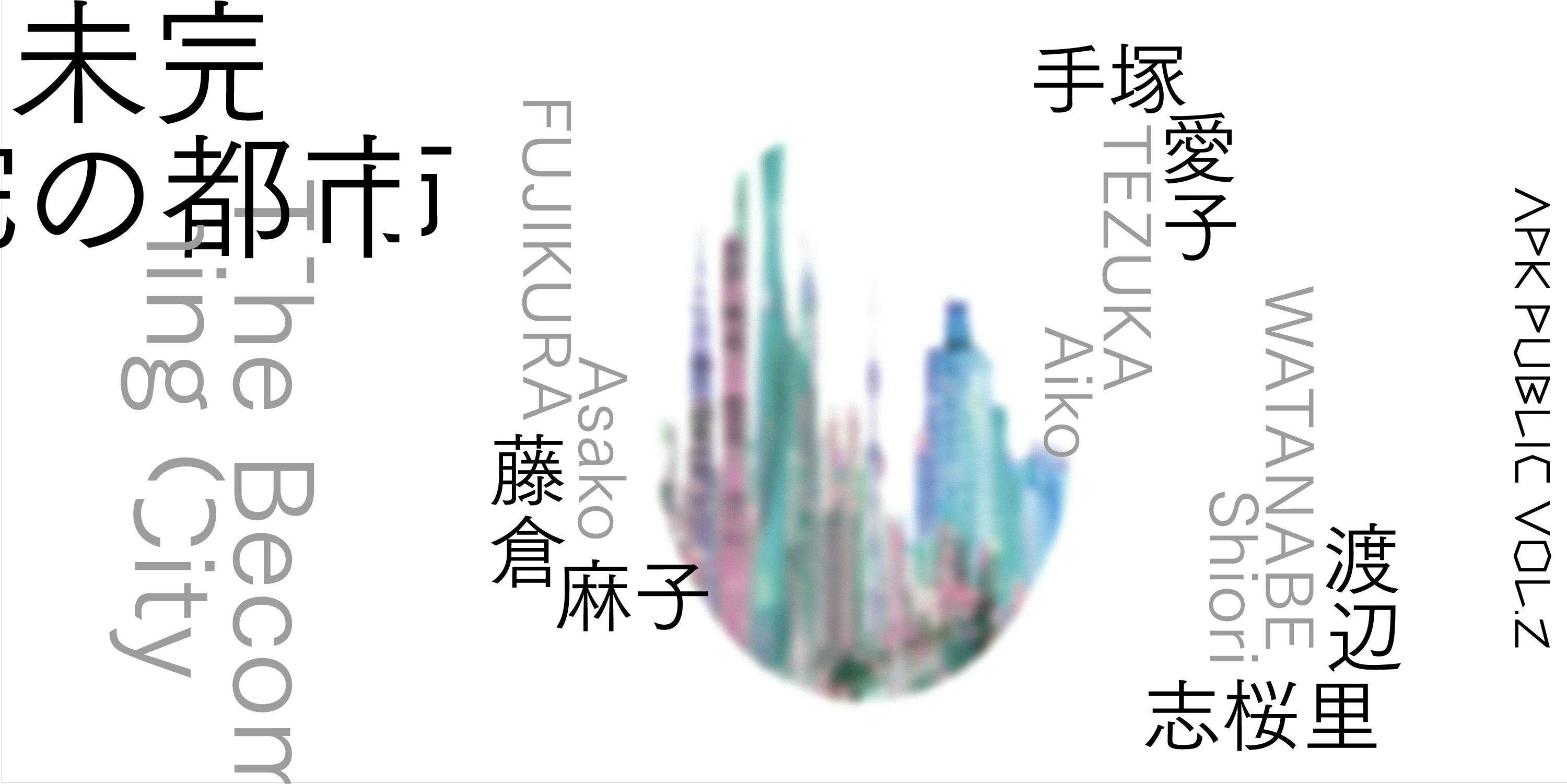
The common space of the Toda Building will be used as a venue for forward-looking public art, offering emerging artists and curators opportunities to present large-scale works that engage with the urban landscape. APK Public is a public art program that enriches the ways people live and work, allowing visitors and office workers to engage with artworks on a daily basis, and aiming to stimulate creativity and expand perspectives.
Vol. 2, curated by Tomoko Yabumae of the Museum of Contemporary Art Tokyo, has the concept of “The Becoming City”. It presents works by three artists, Aiko Tezuka, Asako Fujikura, and Shiori Watanabe.
The Becoming City
Toda Corporation, with headquarters in the heart of Tokyo, has been involved in building and rebuilding the city since the Meiji era (1868–1912). Presented in the public spaces of the new Toda Building, this project brings together new works by Aiko Tezuka, Asako Fujikura, and Shiori Watanabe, specifically commissioned for this site, exploring what the city is and how its image might be recast. These works render visible the forces that produce the urban environment: politics, capital, logistics, collective desires, and historical causality. A city is a process of friction in which these forces collide, and it emerges only in an unsettled state of becoming.
Aiko Tezuka imagines the city as a single body, and her work engages with the story of its making and unmaking, the constant cycle of destruction and construction through which the city comes into being. Ceremonial garments from state rituals, antique maps, shopping lists, nail art: through these layered images, extending from the architects of modernity to the everyday lives of people today, an unbroken chain of human making emerges.
If the making of the modern city is bound up with desires that reach vertically upward, Asako Fujikura’s work presents a vision of horizontality. Another entrance opens at the building’s portico, and through it appears an alternative, fictional metropolis governed by the external logic of sunlight.
Even on construction sites pursuing maximum efficiency, the Shinto groundbreaking ceremony remains indispensable. Drawn to such spiritual practices that survive into the present, Shiori Watanabe focuses on the ceramic vessels buried beneath Noh stages as acoustic resonators. Her work listens for echoes of voices that linger in the deep strata of the city and the nation, suppressed during their formation yet never wholly silenced.
The artists’ imaginations introduce subtle and singular details into the pristine space of the new headquarters, inviting us to picture the city beyond the limits of rationality and standardised value systems. When we do, a passage opens onto the deeper inherent richness of the world, dense with accumulated memory, chance, and unforeseeable futures. All the while, these works remind us that everything is in a constant state of becoming, and that no place can ever be controlled or possessed.
—Tomoko Yabumae
INFORMATION
- Dates
June 1, 2026 - November 30, 2027
- Hours
7:00 am - 11:00 pm (Open daily except January 1)
- Venue
Toda Building Square, 1-2F Entrance lobby(1-7-1 Kyobashi, Chuo-ku, Tokyo)
- Admission
Free
- Organized by
Toda Corporation
- Sponsored by
Kawashima Selkon Textiles Co., Ltd.
HP Japan Inc.
- Artists
Aiko Tezuka, Asako Fujikura, Shiori Watanabe
- Curator
Tomoko Yabumae
Aiko Tezuka Embracing What Lives (A Study of TODA CORPORATION’s History)
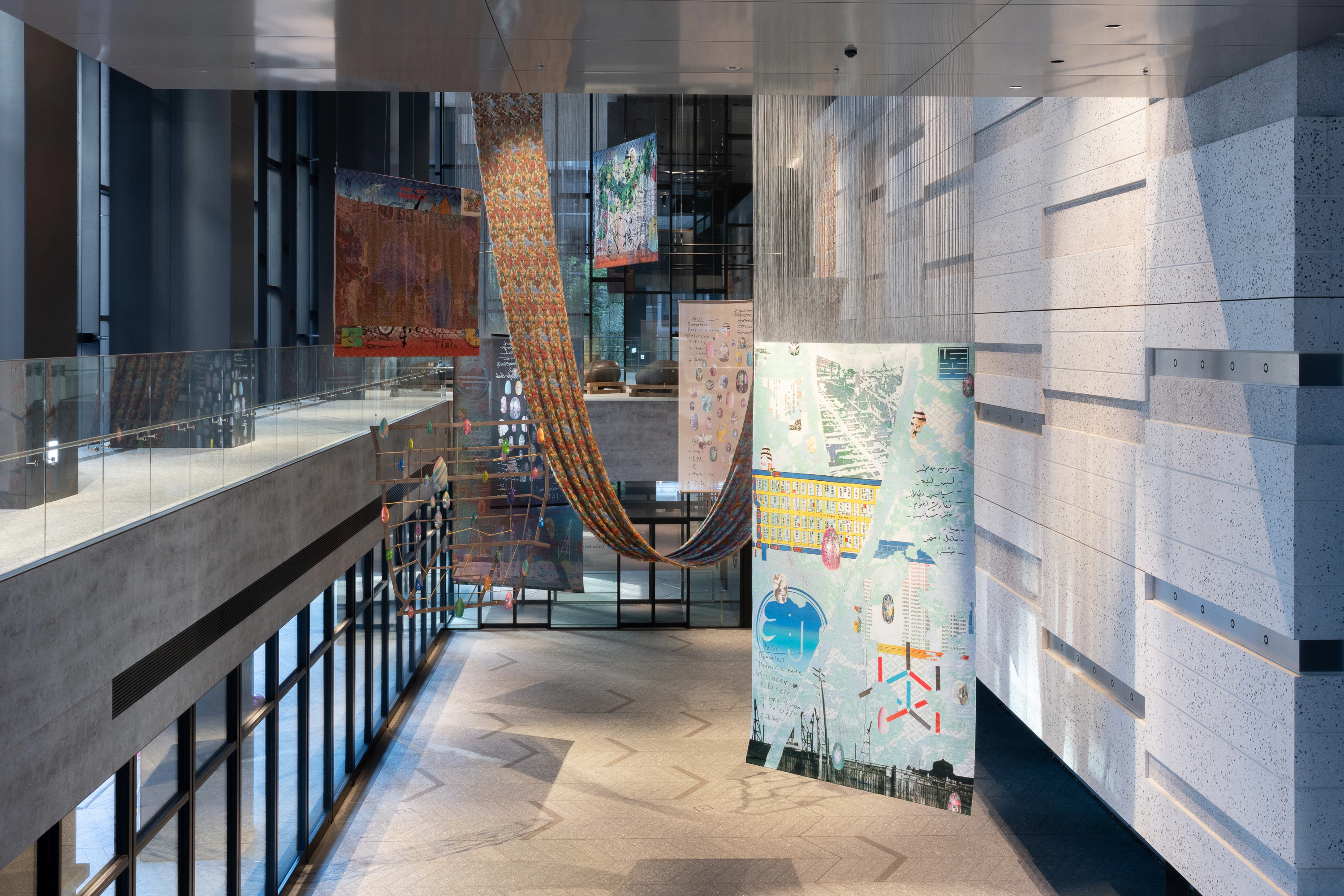
Embracing What Lives (A Study of TODA CORPORATION’s History)
2026
Jacquard weaving (EPOTEX, designed by Aiko Tezuka), sublimation transfer print on chiffon, wood, bamboo, PLA resin, organza, rhinestones, thread, beads, ready-made textile, and aluminum
Photo: Shintaro Yamanaka
Textile Production and Sponsorship by Kawashima Selkon Textiles Co.,Ltd.
Historical Materials Coutesy of Toda Corporation, the Osaka Museum of History, and Kawashima Textile Museum
Historical Map Research Support by Shinsendo Bookstore Co., Ltd.
Sublimation Transfer Print on Chiffon by Nissha Printing Communications, Inc.
By taking apart, unraveling, and reweaving textiles and embroidery, Aiko Tezuka renders visible the time and history accumulated within them. In a practice that has grown out of questions about painting, she treats fabric not as a passive support but as a structure in which handwork, technique, and
institutions intersect. In recent years, she has also produced installations that, drawing on emblematic imagery from modern history, link individual lives and bodies to history writ large.
At the entrance, Tezuka stages a space in which the history of the modern city, with its cycles of demolition and rebuilding, can be apprehended in layers. One work, taking its cue from Marshall Islands stick charts (woven frameworks of palm ribs that map ocean swells), takes the form of a map that translates
relations between places into bodily perception. Another, incorporating modern textile history, addresses the theme of the Expo. Shown alongside these is a new work in Nishijin weaving that invokes the history of central Tokyo, including the area around Toda Corporation’s head office, from the late Edo period (1603–1868) to the present, through a bodily imagining of metabolic renewal. Within a space enveloped by ceremonial robes once used in the state ritual of the eye-opening of the Great Buddha at Todai-ji Temple, antique maps, the history of Toda Corporation, and scenes from the building of modern Tokyo
are layered together. Set against this, images such as a stranger’s shopping list the artist picked up on the street, or decorated fingernails, point to the daily lives lived there. Between hard structure and soft body, the contours of the city emerge as a ghostly presence.
Asako Fujikura Open Sunrise City Protocol
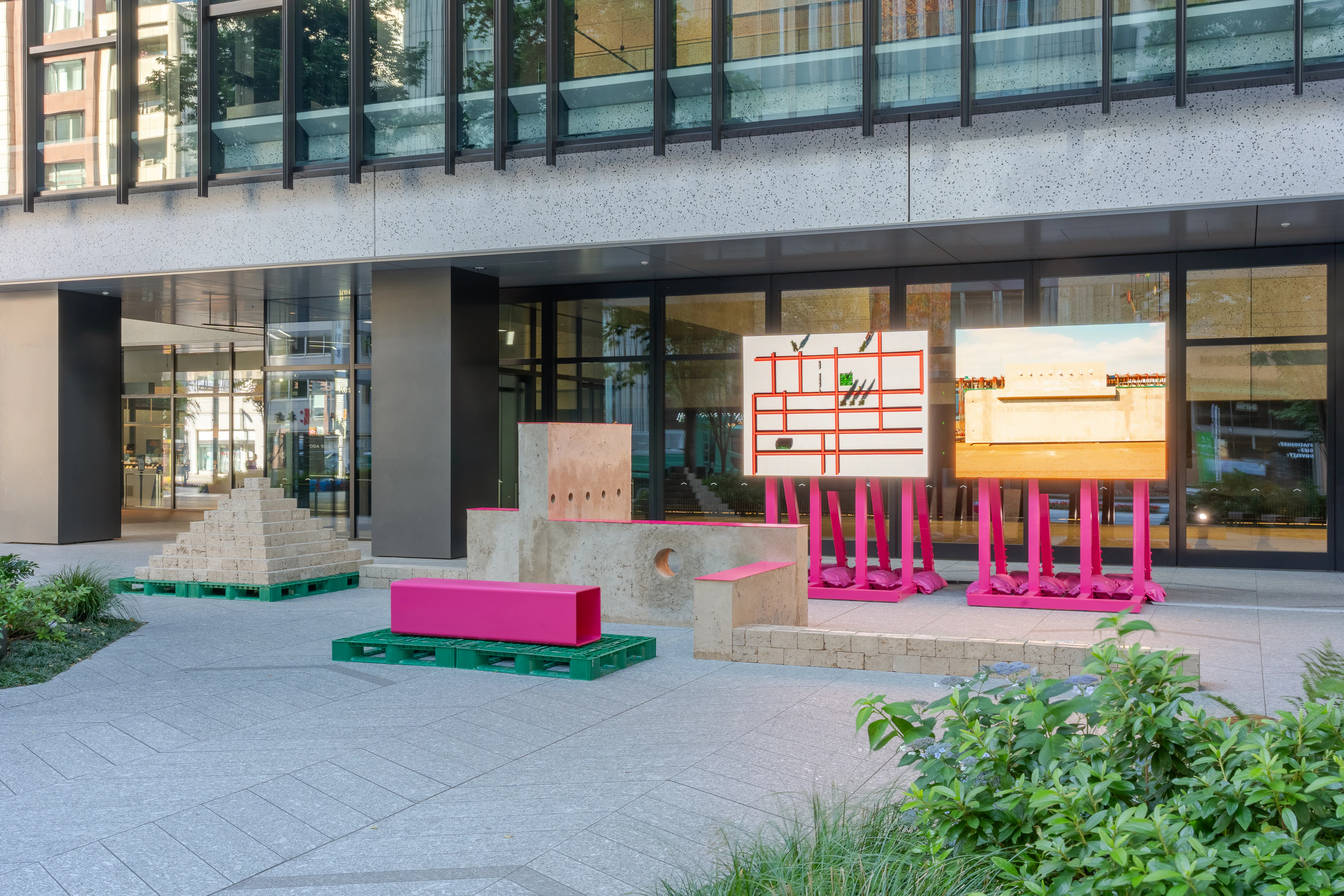
Open Sunrise City Protocol
2026
Video, sun-dried bricks, earthen walls, steel columns, plastic pallets, LED display, speakers
Photo: Shintaro Yamanaka
Sponsored by HP Japan Inc.
Filming Supported by Waseda University, FaB-Tec Japan Corporation, Mitsubishi UBE Cement Corporation, MUCC Construction Materials Corporation., Ishidukenzai Co., LTD., Numatakenzai Ltd., Toda Corporation Narita Factory
Supported by Procurement Station Co., Ltd., ISUNG Japan Co., Ltd., SUCCESS DIGIPLUS CO.,LTD
Asako Fujikura focuses on the infrastructure and logistics that penetrate cities and suburbs, recasting these landscapes in computer-generated 3D animation. The results are environments rendered at scales beyond the human, or utopian settings glimpsed from non-human vantage points, presented as alternatives to the cities we currently inhabit.
In this work, a fiction unfolding around the imaginary metropolis “Open Sunrise City” is overlaid on present-day scenes from Tokyo’s outskirts, where ongoing development is reshaping the land. The city is a two-tiered world shielded by a colossal rock formation, designed to block an ever-fiercer sun while continuing to admit the morning light with maximum efficiency. Built jointly
by humans and AI, the city itself functions as an operating system, linking vast spans of time in parallel and, possessed of a will of its own, keeping watch over everything that unfolds within it. People stack sun-dried bricks, taking part in the building of the city of their own volition. Cypress trees signal fissures in the
city’s workings, and there are workers who have synchronized themselves to the more-than-human time-scale of the operating system. Within this narrative of control interlaced with deviation, a vision emerges of a city that expands and proliferates outward rather than upward, growing without a center. Seated on the sun-dried bricks piled before the screen, viewers find themselves, in the middle of a real city, immersed in the dream of a city not yet seen, asking why humans need urban spaces at all, and what the conditions of a good life within them might be.
Asako Fujikura's Statement Coming soon
Shiori Watanabe Stock, Jirei
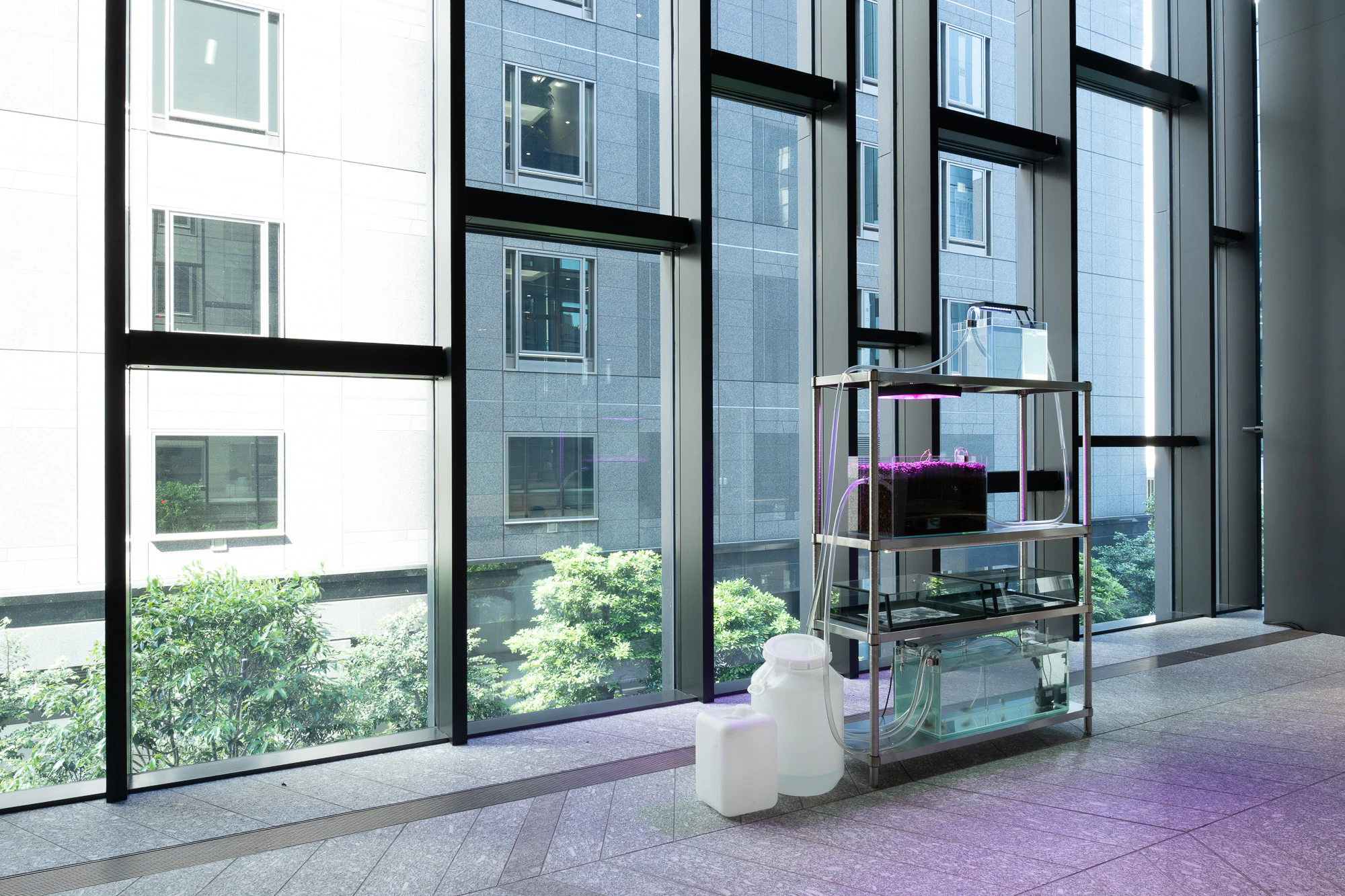
Stock
2026
Mixed media
Photo: Shintaro Yamanaka
Jirei
2026
Mixed media
Photo: Shintaro Yamanaka
Research Supported by KINAN ART WEEK
Supported by Yuichi Akiba, Ryuta Ushiro, Shinjuku Kabukicho Nobutai, Sado Island Galaxy Art Festival, Toda Corporation, Aiko Hashizume, Yuko Ban, Keiko Hayashi, Wataru Shoji, Taiko Sangyo Co., Ltd., EPPU PROJECT, Yutaka Yasuda (Beppu University),
Shingo Miyamoto, Morito Yoshida
Shiori Watanabe is an artist who examines the complex, tangled systems of relations between humans and other living things, from ecosystems to families, communities, and nations. Her work interrogates the structures through which exclusion and power arise, pursuing a decentered mode of thought.
Stock is a series that expands her signature work Sans room through the process of plant division. In her installation, the circulation of plants, fish, bacteria, and water sustains an environment that regulates itself and continually transforms
itself. In an ongoing project, Watanabe loans this ecosystem to companies for set periods, playing on the double sense of “stock” as shares in a company and as a plant divided at the root for propagation. When the economic life of the city is connected to a nonhuman environment, long-held concepts such as value
and ownership are called into question.
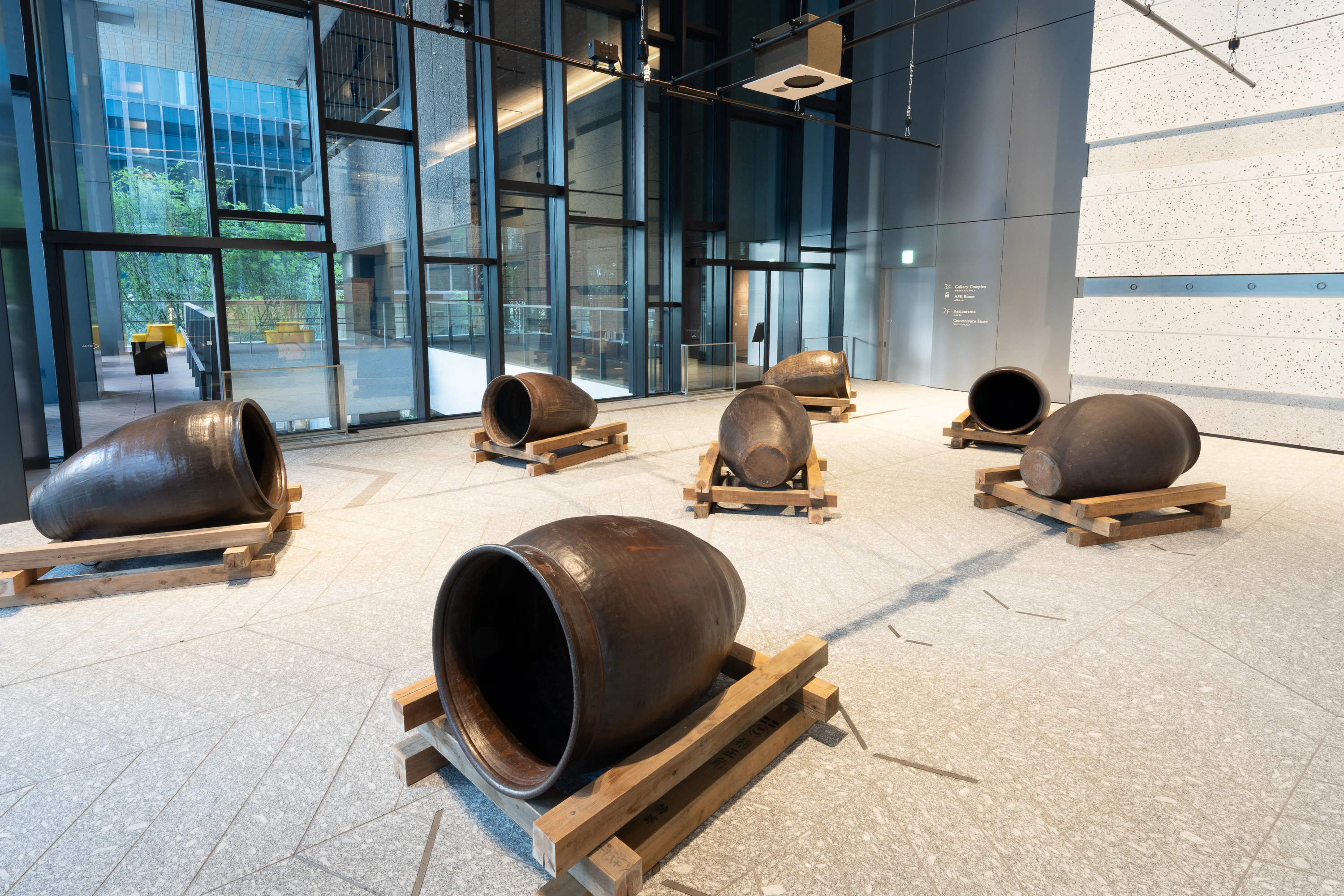
Jirei (Spirits of the Land), a new work created for this project, is inspired by the ceramic jars long buried beneath Noh stages to amplify their acoustics. On an invisible stage formed by a hidden array of jars, voices invoke beings subjugated in the course of the nation’s formation. These figures from legend and folklore include Ura, the ogre said to have been defeated by Momotaro;
the Tsuchigumo (a clan portrayed as spider-like outsiders); and the Hayato (a people of southern Kyushu who were brought under Yamato rule). The space resounds with the foot-stamping of Noh, derived from a ritual practice for warding off evil and purifying the land. Does this sound quiet these long-buried
voices, or call them forth? Just as the earthquakes that have repeatedly struck Japan have both caused destruction and brought about renewal, here the space resonates with ambiguous possibilities.
ARTISTS
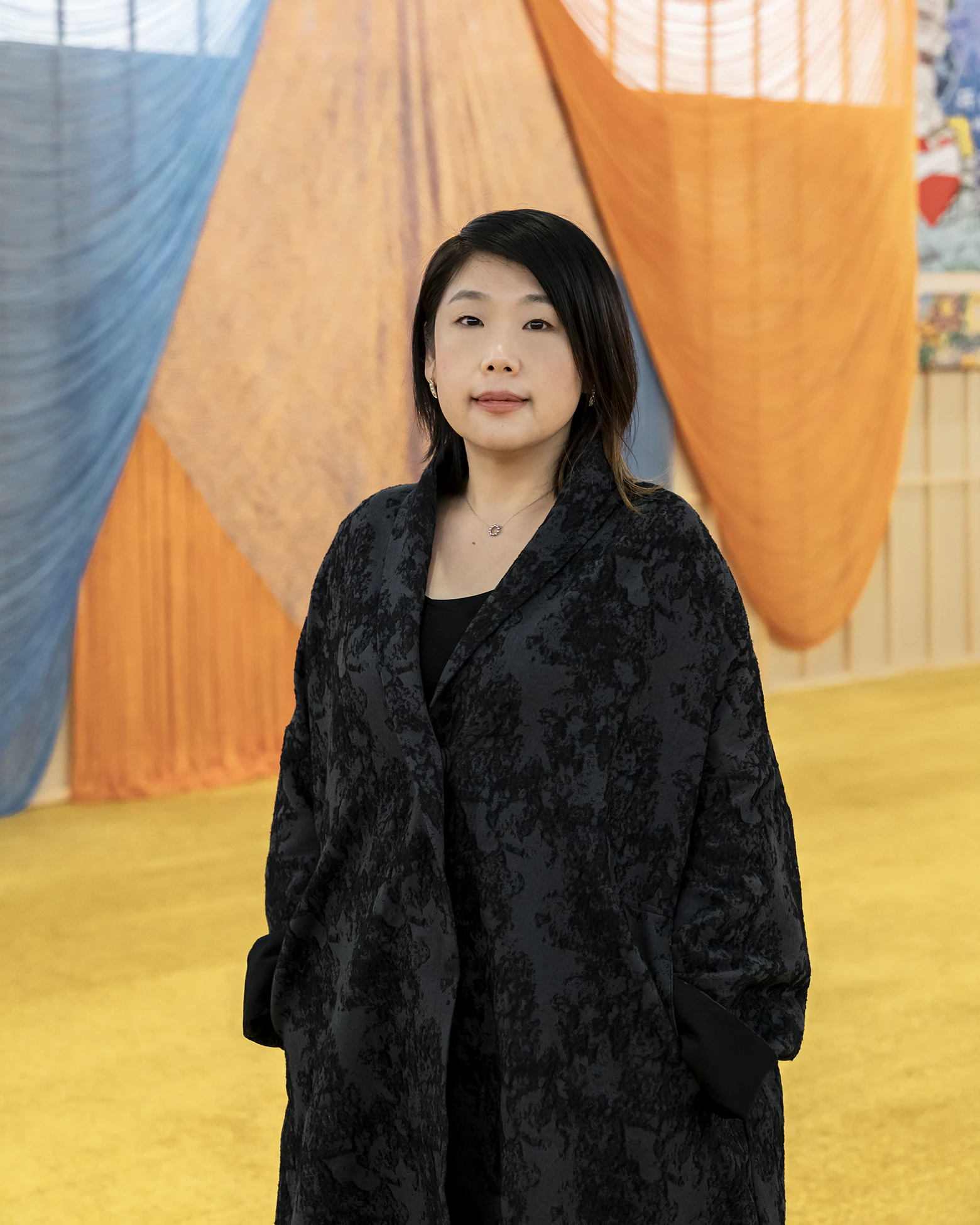
Aiko Tezuka
Born in Tokyo in 1976. Lives and works in Berlin and Tokyo. In 2001, she completed a master’s degree in painting at Musashino Art University, Tokyo, and in 2005, she completed the doctoral program in painting at Kyoto City University of Arts. From 2010 to 2011, she lived and worked in London after receiving the Gotoh Cultural Award Newcomer’s Prize in Art. She subsequently moved to Berlin on a fellowship from Japan’s Agency for Cultural Affairs Program of Overseas Study for Upcoming Artists. Since 1997, she has produced works in which she unravels and reconfigures woven materials, drawing on and editing historical forms to create new structures. Tezuka’s works are included in the collections of the National Museum of Art, Osaka; the National Museum of Modern Art, Kyoto; the Museum of Contemporary Art Tokyo; the Museum of Asian Art, Berlin; and the National Museum of Modern and Contemporary Art, Korea, among many others.
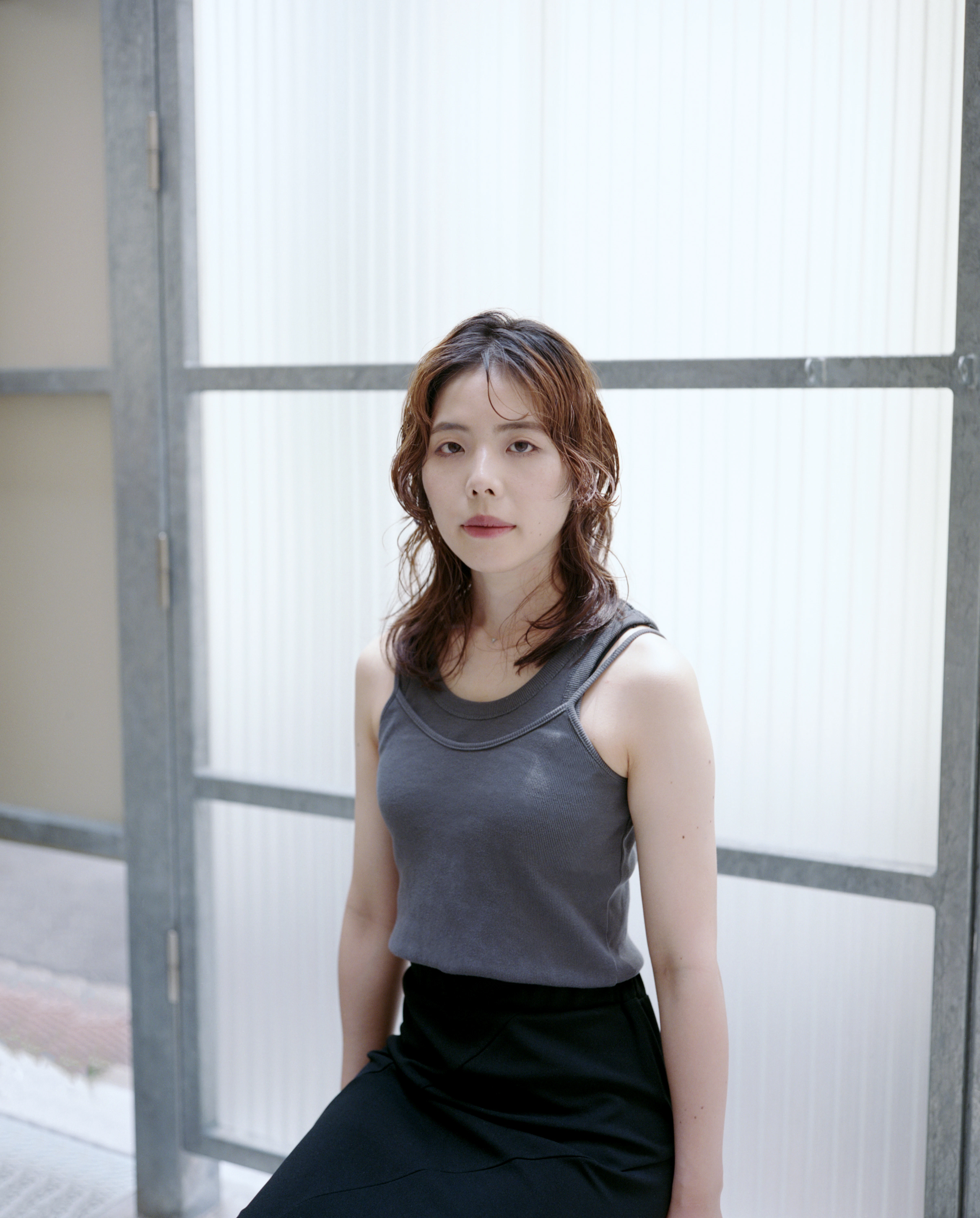
Asako Fujikura
Born in Saitama Prefecture in 1992. Lives and works in Tokyo. Fujikura focuses on infrastructure that links cities and suburbs and how landscapes take shape around it, and produces works primarily using 3D computer animation. In recent years, she has pursued a spatial practice that foregrounds the dynamism of logistics constantly unfolding across reclaimed land and the emergence of gardens within the city. Recent exhibitions include Machine Love: Video Games, AI, and Contemporary Art (Mori Art Museum, 2025) and In-Between: A Future with Generative AI (Japan Pavilion, Venice Biennale of Architecture, 2025).
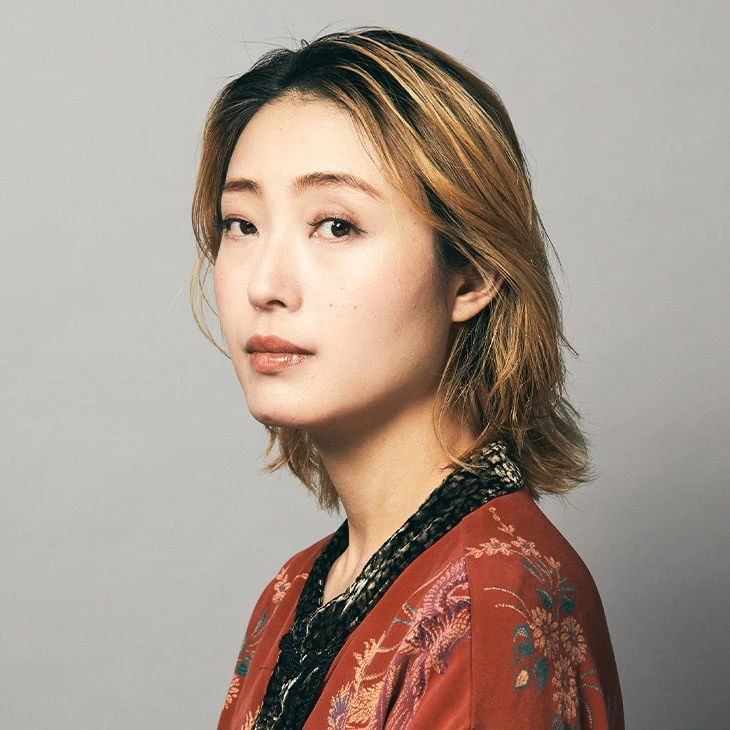
Shiori Watanabe
Born in Tokyo in 1984. Graduated from the Department of Sculpture, Faculty of Fine Arts, Tokyo University of the Arts in 2015, and completed graduate studies at the same university in 2017. Sans room, an installation widely known as one of Watanabe’s key works, links tanks in which plants, fish, and bacteria collected from the Imperial Palace, where she often played as a child, are cultivated, with water circulated between them to form an artificial ecosystem. Underlying her practice is a unique approach to observing the dynamics of extinction, conservation, and exclusion at play among all species, the nation-state as an aggregation viewed from an ecological perspective, and the ties between nature and human activity embedded in folk customs and ritual practices.
CURATOR

Tomoko Yabumae
Born in Tokyo in 1974. As the curator of Museum of Contemporary Art Tokyo, she was in charge of curating the following exhibitions: Shinro Ohtake Zen-kei Retrospective 1955-2006 (2006), Sayoko Yamaguchi: The Wearist, Clothed in the Future (2015), An Art Exhibition for Children: Whose place is this? (2015), Eiko Ishioka: Blood, Sweat, and Tears-A Life of Design (2020), Christian Marclay Translating (2021), A Personal View of Japanese Contemporary Art; Takahashi Ryutaro Collection (2024) and Kenjiro Okazaki 而今而後 Time Unfolding Here (2025). She also curated Sapporo International Art Festival 2017 and others. Her writing on contemporary art and culture as a whole has appeared in numerous journals and web media.